
02.02.26
BIPP–ISB and Terviva Partner to Strengthen Karanj-Based Forest Value Chains through Women-Owned Enterprises
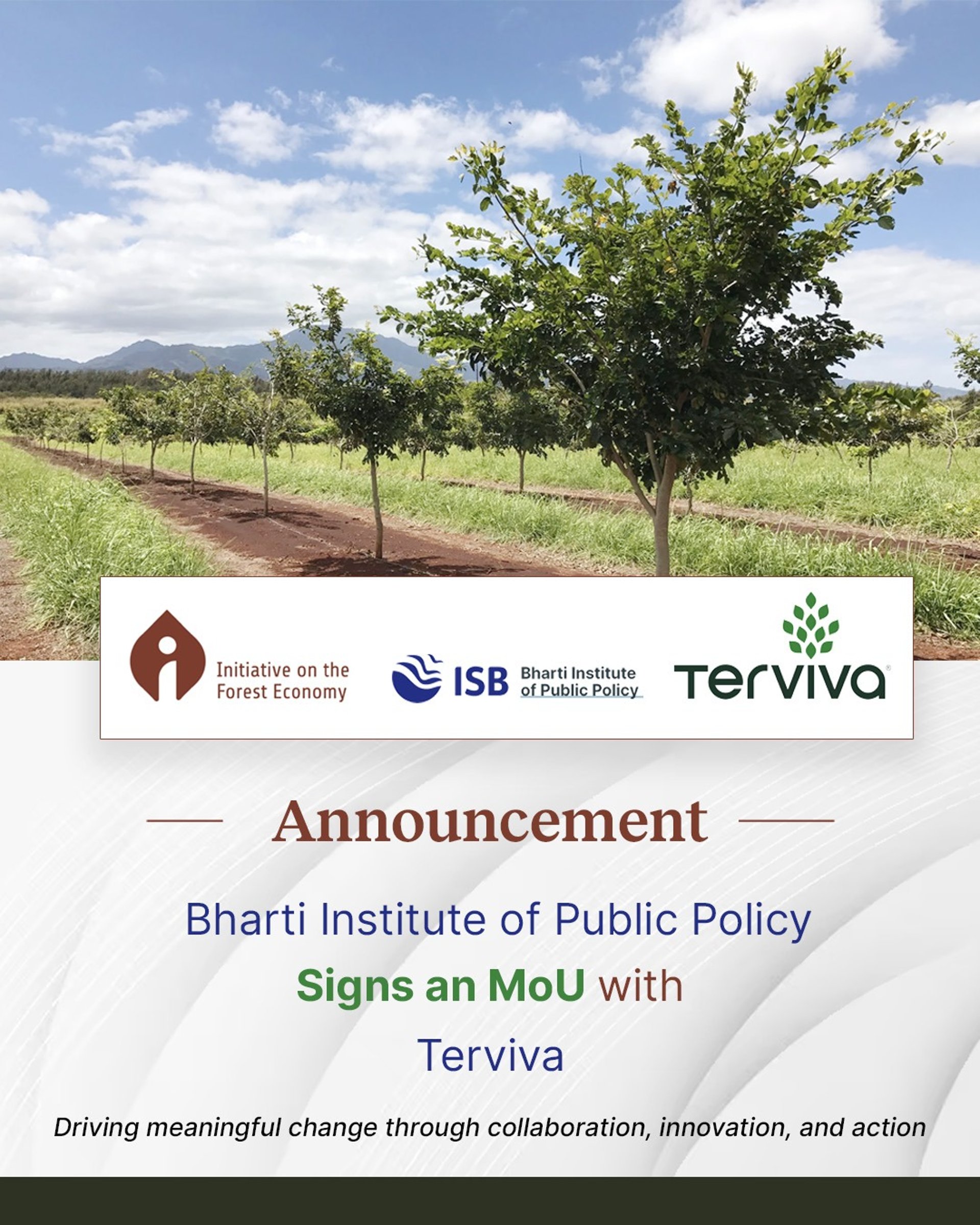
Building on the Karanj (Pongamia pinnata) seed sale in Odisha in 2025, a three-year Memorandum of Understanding (MoU) was signed on 30 January 2026 between the Bharti Institute of Public Policy (BIPP) at the Indian School of Business (ISB) and Terviva India Private Limited. The collaboration seeks to develop structured, transparent, and sustainable market systems for Karanj seeds by strengthening supply chains, improving institutional capacities, and enhancing market access for women-owned, forest-based producer companies (PCs).
Scope of Work
The collaboration will focus on the following areas:
strengthening aggregation, quality assurance, and fair pricing systems for Karanj seeds at the PC level;
ensuring timely payments and supporting access to working capital where feasible;
building institutional capacity through training on grading, post-harvest handling, packaging standards, and sustainable harvesting practices;
strengthening supply chain coordination and enabling stronger linkages between community enterprises and industrial markets;
identifying and operationalising appropriate technology and mechanisation solutions to reduce drudgery and improve efficiency in collection and processing;
mapping the distribution and abundance of Karanj to guide planning, aggregation, and market readiness;
documenting field learnings, developing case studies, and sharing knowledge products for wider dissemination; and
co-developing frameworks for sustainability, monitoring, and impact measurement at the PC and community levels
Roles and Responsibilities
BIPP–ISB will facilitate linkages between Terviva and forest-based PCs and support the mapping of Karanj distribution and availability to strengthen planning and market readiness. BIPP–ISB will also co-organise training programmes, workshops, and orientation sessions for PCs, while contributing to research, documentation, and the development of case studies. In addition, it will support the identification of technological solutions to address field-level challenges.
Terviva will serve as the supply chain partner for Karanj seeds aggregated by PCs. It will support the design of aggregation models that improve efficiency and foster economies of scale, and provide technical training on quality standards, grading, packaging, and trade practices. Terviva will also coordinate procurement, logistics, warehousing, and buyer fulfilment, while ensuring transparent procurement systems and timely payments to PCs.
By combining market system strengthening, institutional support, technology solutions, and research, the collaboration aims to build scalable models for Karanj-based forest economies. These efforts are expected to enhance livelihood security for forest-dependent communities while promoting ecological sustainability and responsible forest stewardship.