
03.03.26
A Historic First: Bamboo Sale from Community Forest Rights Area Through a Tribal Women-Owned Producer Company
In a quiet forest village in Maharashtra's Nandurbar district, a development with national implications took shape on 27 February 2026. A truck loaded with bamboo left the forests of Legapani village — and with it, a new chapter began in India's community forest rights story. For the first time in the state, bamboo harvested from a Community Forest Resource (CFR) area was sold through a tribal women-owned Producer Company. The sale used a transit permit — the document required to legally transport forest produce — issued for the first time in the new format mandated by the Integrated Tribal Development Agency (ITDA) and printed by the Gram Sabha itself. The consignment comprised 7.5 tonnes of bamboo, an invoice was issued directly by the Toranadevi Jungle Producer Company (PC), and payment was received in full the following day.
From an Untapped Resource to a Community- Owned Organised Enterprise
Nandurbar district has over one lakh hectares of recognised CFR land across approximately 330 villages, with a predominantly tribal population of nearly 69 percent. The challenge has never been resource availability. Bamboo — one of the most valuable and renewable forest resources in the region — has long existed in abundance. The structural problem has been the absence of a value chain connecting community-held forest assets to organised markets, and the lack of local livelihood opportunities that has pushed most of the population to migrate seasonally to Gujarat and other parts of Maharashtra.
Recognising this gap, we facilitated the formation of the Toranadevi Jungle Producer Company Limited, incorporated on 29 December 2025. The company brings together over 300 shareholders from forest-dependent tribal villages across 12 Gram Sabhas in Nandurbar's Dhadgaon (Akrani) and Shahada blocks. It is women-owned, with a Board of Directors representing different villages — women who were once only collectors of forest produce are now shareholders and directors of a community-owned enterprise.
The approach is anchored in four building blocks of change — secure land tenure, business ecosystem creation, enterprise cultivation, and multi-stakeholder partnerships. In Nandurbar, this translates into three interdependent institutional layers: the Gram Sabha as the statutory rights-holding body under the Forest Rights Act; the Community Forest Resource Management Committee (CFRMC) as the governance and harvesting institution responsible for ensuring scientific extraction; and the Producer Company as the market-facing entity linking community bamboo to industry. By aggregating produce at the company level, tribal communities gain negotiating power, assured buyers, and better price realisation. The District Administration has been a critical partner in enabling convergence across the Forest and Tribal Development Departments, MSRLM, and MGNREGA — bridging the gap between state systems and community institutions.
The Inauguration
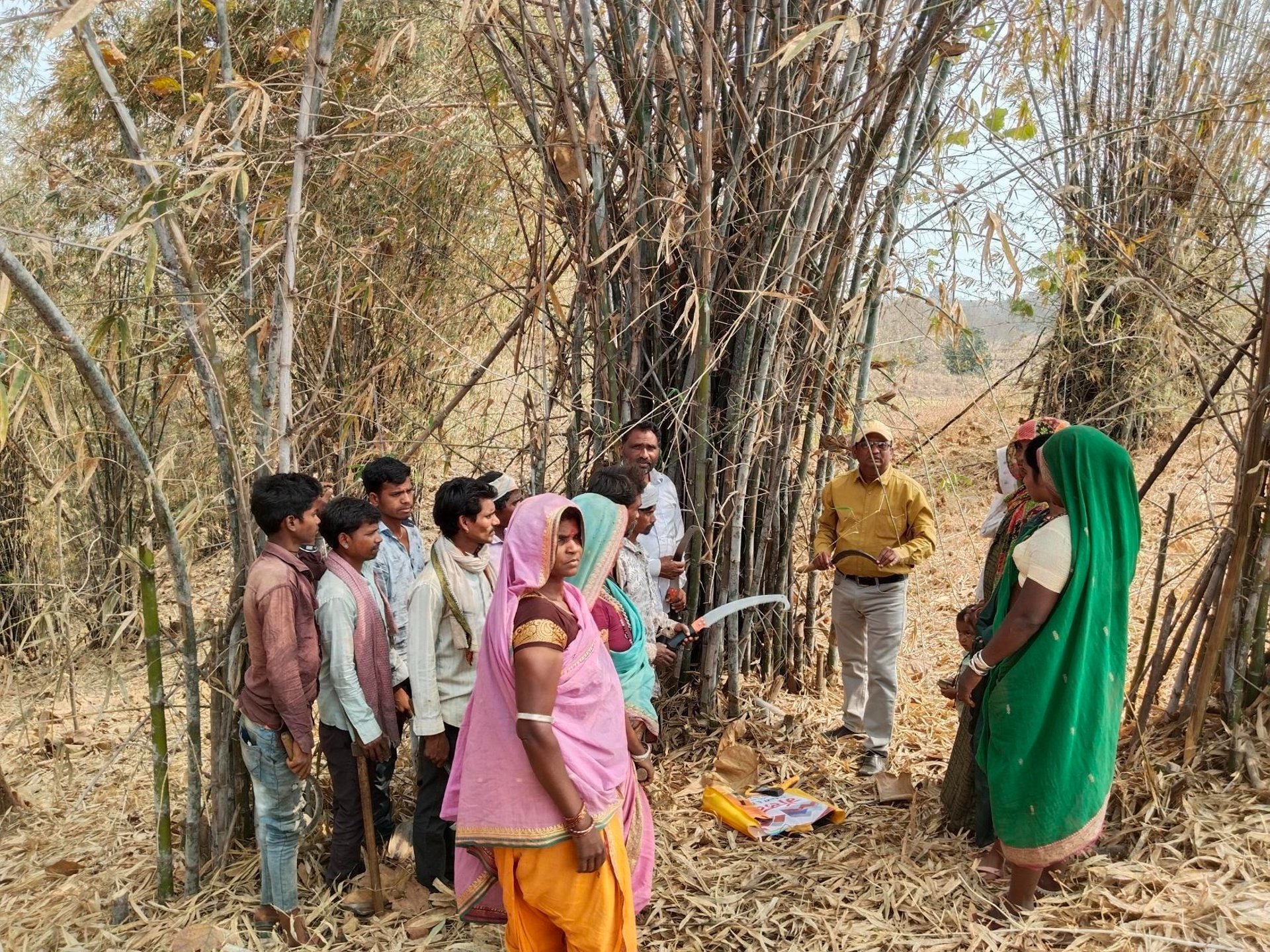
On 20 February 2026, the formal inauguration of community-led bamboo harvesting at Legapani marked the operationalisation of this model. The ceremony brought together District Collector Dr. Mittali Sethi, MLA Amsha Padwi, PO-ITDA Anay Navandar, officials from the Forest Department, CFRMC members, and the Board of Directors of Toranadevi Jungle Producer Company. Following the speeches, attendees walked to the community forest area to cut the ribbon and plant bamboo saplings — marking the formal beginning of the initiative. The MLA underscored the importance of establishing local bamboo processing units to generate additional employment. The District Collector commended the community's leadership and encouraged the CFRMC to adopt sustainable, responsible practices in managing forest resources.
Harvesting commenced the following day with structured systems of accountability from the outset — attendance recorded morning and evening, harvest volumes jointly verified by the CFRMC President and Treasurer, designated supervisors overseeing the site, and a first-aid box placed on-site to ensure worker safety. In total, the community had harvested 1,401 bamboo poles, systematically stacked at a designated collection point.
Historical Significance of the Sale
The 27 February sale is historic for several reasons. It marks the first bamboo sale in Maharashtra conducted through a community women-owned Producer Company under Community Forest Rights. It is also the first use of the new ITDA-issued transit permit format printed by the Gram Sabha — a tangible demonstration of community authority over forest produces in formal commercial channels. Payment was received in full the following day, with no intermediaries extracting value from the transaction. CFRMC members worked continuously through the day to ensure its smooth completion.
The Producer Company follows a transparent benefit-sharing structure: 90 percent of the surplus is transferred to the CFR Management Committees for forest regeneration and community welfare, and 10 percent is retained by the Producer Company to build working capital over time.
The Road Ahead
The company currently operates across 11 villages covering 11,666.88 hectares of CFR area — one of the largest community-governed forest landscapes in Maharashtra. With growing demand from the industries involved in biofuel and green energy production, bamboo is increasingly a strategic resource. Beyond bamboo, the PC is positioned to diversify into Chironji, Forest Gum, Beheda, and Hirda. The next phase involves expanding shareholder membership, developing village-level storage infrastructure, building long-term market partnerships with industrial buyers, and introducing local processing and value addition.
Nandurbar is demonstrating that Community Forest Rights, when backed by the right institutions and partnerships, can form the foundation of a green and inclusive economy.
The Toranadevi Jungle Producer Company stands as an early and powerful demonstration that forests, communities and markets can come together — through rights, institutions, and enterprise — to build a new rural economy.