
04.05.26
From Forests to Institutional Markets: Toranadevi Jungle Producer Company's Next Milestone
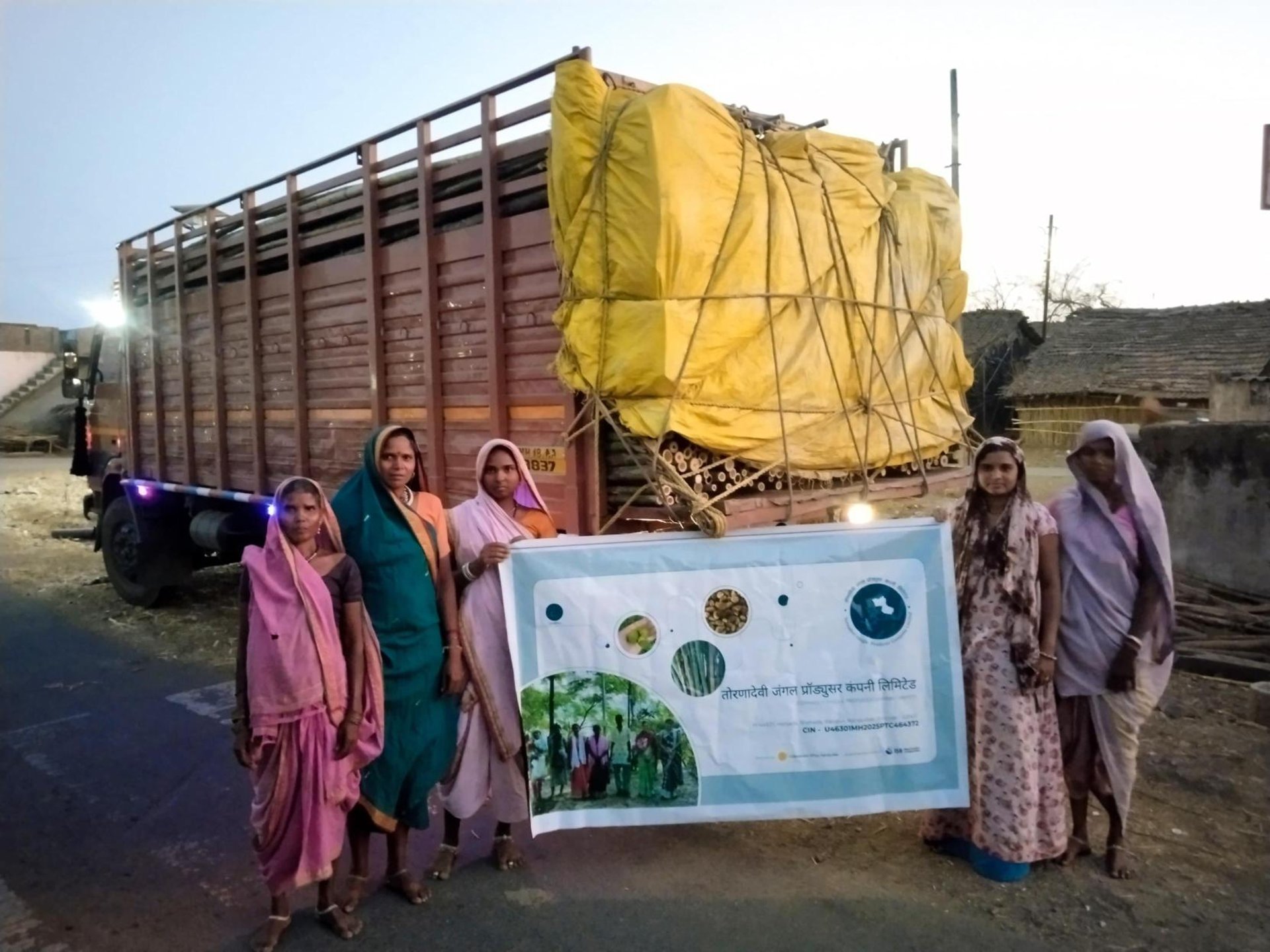
On the evening of 30 April 2026, a truck carrying 1,010 bamboo poles left Legapani village in Nandurbar, Maharashtra, for the Centre for Indian Bamboo Resource and Technology (CIBART), Navsari, Gujarat. This first sale by the Toranadevi Jungle Producer Company (PC) to an institutional bamboo buyer marks a major achievement for forest-dependent communities in India.
Overview of the Sale
The nature of the buyer distinguishes this transaction from the PC’s earlier sale to a local trader. CIBART is a not-for-profit organisation working on bamboo research and development across multiple Indian states. It promotes bamboo-based livelihoods and sustainable enterprise development with communities, artisans, and farmers. The consignment — invoiced at ₹1,01,537.5, inclusive of raw material costs, 5% Goods and Services Tax (GST), and transportation charges — was transacted entirely through the PC, with no intermediary in the chain. This, in itself, is a significant statement.
Benefit-Sharing Structure
While the first sale of 7.5 tonnes of bamboo demonstrated that Community Forest Rights (CFR) could be commercially exercised, this sale demonstrated something equally important: that the right benefit-sharing structure can mobilise communities from within. In discussion with the Sarpanch and members of the Community Forest Resource Management Committee (CFRMC), the group moved away from a fixed wage-per-pole model. Instead, they agreed on a revenue-linked approach:
• 10% to the PC to build working capital;
• 10% to the CFRMC for forest governance and regeneration;
• a portion towards operational costs such as local transportation and loading; and
• the remainder distributed among community members who participated in harvesting and transport.
The impact of this structure was immediate and visible. On 28 April, 24 members participated in harvesting. The next day, that number rose to 40. By 30 April, the poles had been loaded and dispatched. Over these three days, the community collectively harvested and transported approximately 1,500 bamboo poles to the common collection point — more than what ultimately went into the truck, ensuring quality selection and buffer stock. This is what genuine participation looks like when community members see themselves as stakeholders in an outcome, rather than as daily wage earners.
Significance of the Direct Industry Linkage
The significance of CIBART as a buyer extends beyond the volume of this particular consignment. Their interest in community-sourced bamboo from CFR-holding tribal villages opens a pathway that conventional commodity traders cannot offer: the possibility of long-term sourcing relationships, quality feedback loops, and potentially, value-added processing at the community level.
Nandurbar’s CFR landscape — spread across 11 villages and 11,666.88 hectares, making it one of the largest community-governed forest areas in Maharashtra — has the scale to sustain such partnerships. With bamboo increasingly positioned as a strategic input for biofuel, green construction, and eco-design, these institutional linkages could become critical to building a sustainable forest-based rural economy.
For the Toranadevi Jungle Producer Company, this sale represents more than a market transaction. It signals the emergence of community-owned forest enterprises as credible participants in institutional supply chains.