
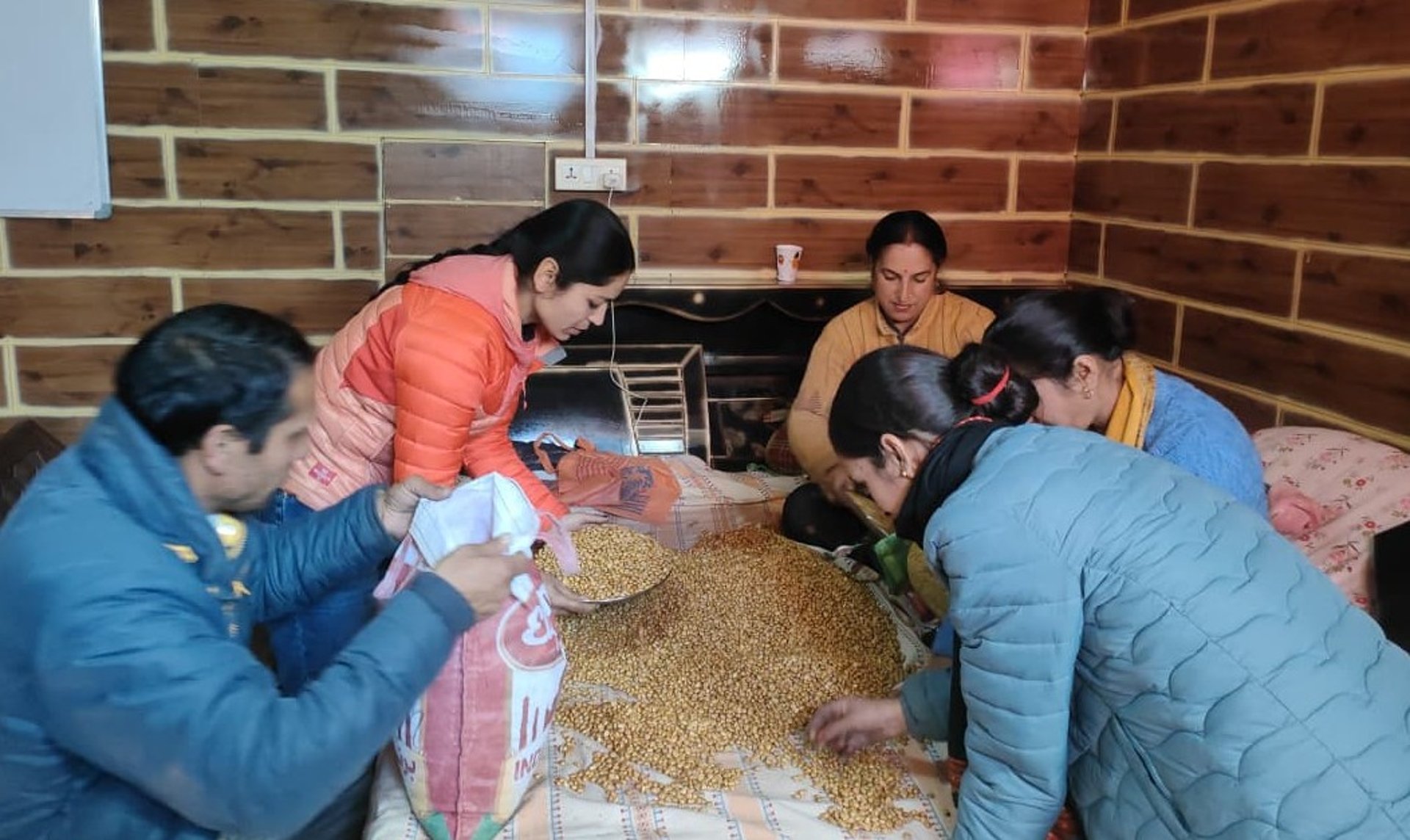
Women members sorting and packing wild Himalayan hazelnuts at the PPJPC office in Killar, Chamba district, Himachal Pradesh.
27.01.26
Pir Panjal Jungle Producer Company Completes Hazelnut Sales in Pangi Valley, Himachal Pradesh
The Pir Panjal Jungle Producer Company (PPJPC), based in the remote Pangi Valley of Himachal Pradesh, has completed its hazelnut sales for 2025. The company sold 1,192.26 kg of wild Himalayan hazelnuts in five consignments to Hyderabad-based Dry Fruitz Basket (DFB), generating a total sales value of ₹35,57,380.40. Out of this amount, ₹1,66,916 was paid as Goods and Services Tax (GST) to the state government.
This season saw higher harvest volumes than the previous year, with 135 producers from 21 villages bringing their produce to the PPJPC aggregation centre at Killar in Chamba district. Women members played a leading role in cleaning, grading, and packing the hazelnuts, ensuring quality before dispatch. The buyer offered ₹2,800 per kg, ensuring transparent and remunerative pricing for primary collectors.
The first consignment, weighing 53 kg, was dispatched on 16 October 2025 and generated ₹1,58,091. It was followed by four larger shipments: 200 kg on 3 November (₹5,97,294), 200.19 kg on 25 November (₹5,97,208.60), 342.17 kg on 6 December (₹10,20,808.80), and 396.9 kg on 13 December (₹11,83,978). Together, these consignments reflect the scale and coordination achieved by PPJPC during the season.
Mr Shivanand, DFB’s representative, expressed high satisfaction with the quality of Pangi hazelnuts and shared positive feedback from customers. He also informed the PPJPC team about the company’s 3-tonne cold storage facility, maintained at 2–6°C, which enables safe storage of large volumes. Building on the successful hazelnut partnership, DFB has also made its inaugural walnut purchase of 15.5 kg from PPJPC at a price of ₹800 per kg. The buyer has further expressed interest in sourcing deshelled pine nuts from the region, opening up new market opportunities for seasonal forest products (SFPs) from Pangi Valley.
The successful sale reflects how organised, women-owned producer enterprises in remote regions can connect effectively with urban markets, creating sustainable income opportunities from the sale of SFPs.