
27.03.26
Forests, Rights, and Livelihoods: The Formation of CFRMCs in Andhra Pradesh's Tribal Heartland
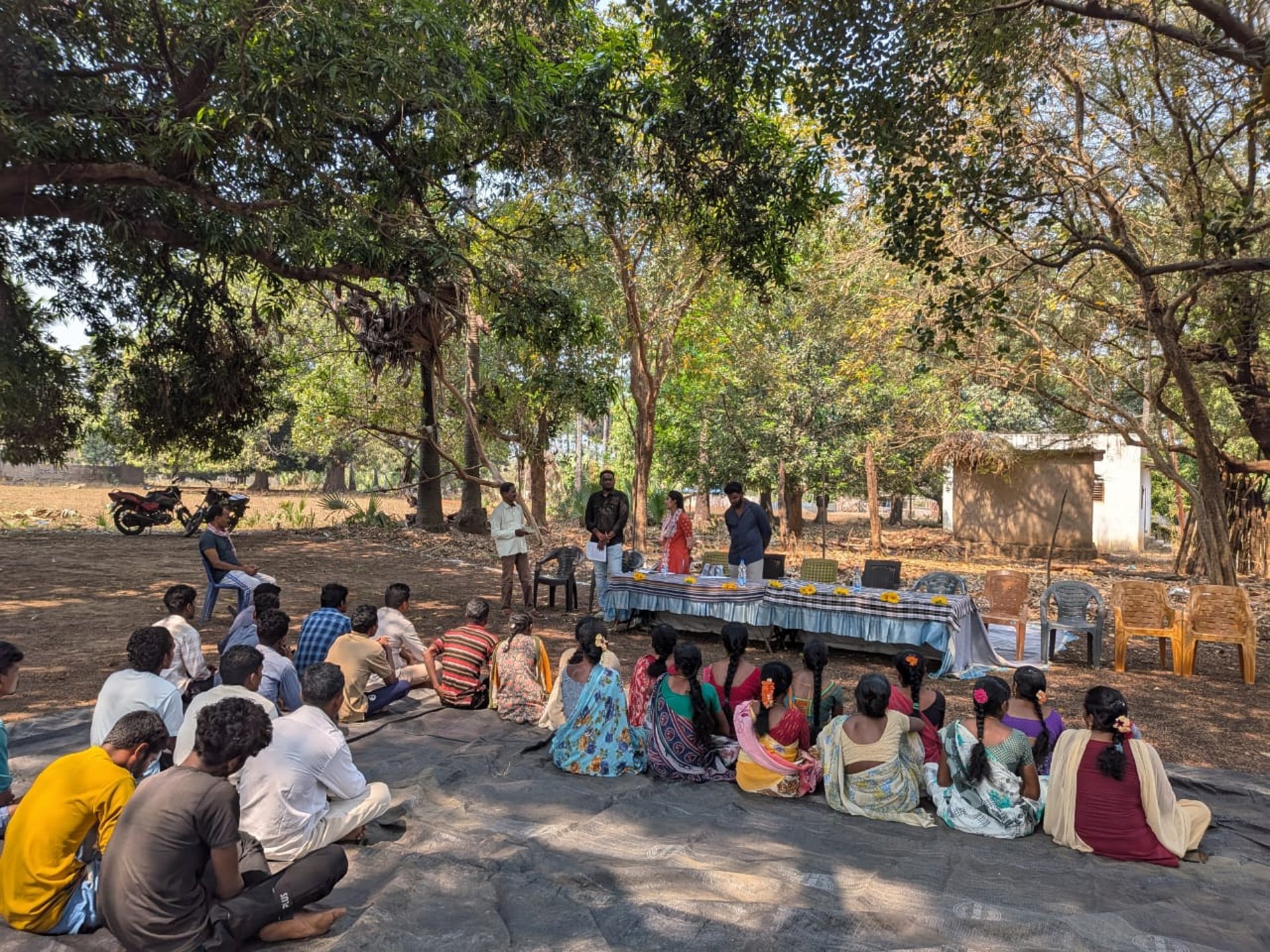
In the dense forested landscapes of Rampachodavaram and Chintoor — tribal divisions nestled within Andhra Pradesh's Polavaram district — a quiet but significant transformation is underway. Community Forest Resource Management Committees (CFRMCs) are being constituted village by village, granting tribal communities not just rights over their forests, but the institutional muscle to manage, protect, and benefit from them. The initiative, rooted in the Scheduled Tribes and Other Traditional Forest Dwellers (Recognition of Forest Rights) Act, 2006, also known as the Forest Rights Act (FRA), is gaining ground steadily — though not without its share of hurdles.
What Is a CFRMC and Why Does It Matter?
The CFRMC is the grassroots institution through which tribal communities exercise their CFR rights under the FRA. Once a village's CFR claim is recognised, the CFRMC takes charge of managing the forest resources within that boundary — deciding how resources are harvested, ensuring equitable distribution of benefits, and representing the community's interests in dealings with the government and market.
In a region where agriculture is largely rainfed, restricted to a single season between July and December, and where borewell permissions are severely limited, forest-based livelihoods are not supplemental — they are central. Seasonal Forest Products (SFPs) and bamboo form the backbone of the local economy. Without strong institutional mechanisms like CFRMCs, communities risk losing access to their own resources to exploitation, administrative neglect, or bureaucratic inertia.
Steady Progress on the Ground
The numbers tell a story of consistent, if gradual, progress. In Rampachodavaram division alone, a total of 230 CFR claims have been approved at the District Level Committee (DLC) and Sub-Divisional Level Committee (SDLC) levels, spanning 159 villages. Of these, 129 Gram Sabhas — the constitutionally mandated village assemblies that are central to the FRA process — have already been convened, and 54 CFRMCs have been successfully formed so far.
This institutional development at the village level is being driven in large part through collaboration with the Society for Elimination of Rural Poverty (SERP). SERP's extensive network of Self-Help Groups (SHGs) has proven to be a vital mobilisation channel, particularly for ensuring women's participation. Their involvement has brought greater awareness of CFR rights to communities and helped Gram Sabhas run more effectively.
The Forest on Their Doorstep: SFPs and Bamboo
The tribal forests of this region are remarkably resource-rich. Myrobalans (Karakkaya), Marking Nut (Bhilawa), and Nux Vomica (Mushti) are among the key SFPs collected and sold by communities. Four Girijan Primary Cooperative Marketing Societies (GPCMS) operate in the Rampa division, providing a structured procurement system. The Girijan Cooperative Corporation (GCC) further supports collectors by bearing transportation costs and standardising loading and unloading charges — a meaningful intervention in reducing the economic burden on forest-dependent families.
Procurement data over the past three years, however, reveals an uneven picture. Myrobalan collection has declined sharply, from 71 tonnes in 2022–23 to 29 tonnes in 2024–25. Marking Nut has shown a more encouraging uptick, reaching 40 tonnes in the latest year. Nux Vomica has fluctuated between 10 and 17 tonnes. These variations point to the pressing need for better systems of aggregation, storage, and market linkage to ensure that collectors are not left vulnerable to seasonal or market-driven fluctuations.
Bamboo presents an even larger, and largely untapped, livelihood opportunity. The region has over 20,000 acres under bamboo, predominantly thorny bamboo species. Field-level estimates suggest approximately one lakh bamboo poles are available, with a sustainable annual harvest potential of 20,000–25,000 poles following a three-year cutting cycle. At market prices of ₹50–₹100 per pole, this represents a significant potential income stream for forest-dependent households — one that is currently constrained by administrative bottlenecks.
Sirasanapalle: A Story of Potential, Setback, and Renewal
Perhaps the most vivid illustration of both the promise and the pain of CFR implementation comes from Sirasanapalle village in Chintoor division. The village received its CFR title in 2014 and wasted no time in putting it to use. By 2016, the community had harvested 57,000 bamboo poles, generating approximately ₹29.2 lakh in revenue — a remarkable demonstration of what organised, rights-backed communities can achieve.
Then came the setbacks. Following Andhra Pradesh's bifurcation, the validity of the village's CFR title came under question. The CFR area was not included in the Forest Department's Working Plan, which became the administrative basis for denying harvesting permissions. Villagers found themselves warned against cutting bamboo — resources they had legitimate rights over — while agriculture offered no viable alternative. The economic consequences were severe, and the spectre of out-migration loomed.
The community, however, held firm. Sirasanapalle showed no inter-village conflicts over forest boundaries, maintained transparent revenue-sharing practices, and demonstrated a consistent willingness to engage in sustainable forest management. That tenacity is now being rewarded: the CFR area has recently been included in the Working Plan, removing the primary administrative barrier that had stalled bamboo harvesting for years. The community is now positioned to revive its bamboo enterprise, and Sirasanapalle is being looked to as a replicable model for resolving similar disputes in neighbouring areas.
The Challenges That Linger
Progress notwithstanding, the CFRMC formation process faces real and persistent challenges.
Gaps in coordination across government departments remain a significant constraint. At times, limited participation in Gram Sabhas has left communities without clarity on critical issues such as boundary demarcation and access to forest resources. This lack of coordinated engagement can create confusion and affect community confidence in the process.
Unclear forest boundaries continue to generate hesitation. Without precise demarcation, communities are uncertain about the extent of their rights and responsibilities — and that uncertainty becomes a barrier to forming and activating CFRMCs.
Procedural delays in approvals, and the slow inclusion of CFR areas in Working Plans, mean that communities with recognised rights still cannot access their forests without risk of legal trouble. This gap between rights on paper and rights in practice is a deeply frustrating reality for many tribal families.
The Road Ahead
The path forward requires convergence — of government departments, community institutions, and support organisations — around a common purpose: making CFR rights real and livelihood-enhancing.
Greater and more consistent participation of relevant government departments in Gram Sabhas will be essential to strengthen coordination and ensure that community concerns are addressed in a timely manner. Boundary demarcation must be expedited. CFR areas must be systematically included in Working Plans so that communities are not trapped in a legal grey zone. And beyond rights recognition, there is urgent work to be done on strengthening SFP and bamboo value chains — through better aggregation infrastructure, processing facilities, and market linkages that allow communities to capture more value from their forests.
Capacity building of CFRMCs — on governance, financial management, and enterprise development — will be essential to transform these institutions from paper bodies into functioning economic and ecological stewards.
A Transformative Opportunity
The CFRMC formation process in Andhra Pradesh is, at its core, a bet on communities. It is a recognition that tribal forest dwellers — who have lived with, protected, and depended on these forests for generations — are best placed to manage them sustainably, provided they are given the rights, institutions, and support to do so.
The region's forest wealth — its bamboo groves, SFP-laden landscapes, and biodiversity — is not just an ecological asset; it is the livelihood base for thousands of families. CFRMCs, when fully constituted and empowered, can become the institutions through which these communities move from subsistence to enterprise, from vulnerability to resilience.
Sirasanapalle has shown what is possible. What remains is the political will, inter-departmental coordination, and sustained support to replicate that possibility — village by village, across the forested highlands of Andhra Pradesh.